
Free Digital Marketing Services for Food Business: A Practical Guide
Running a food business is already a full-time job.
You have customers to serve, ingredients to manage, staff to coordinate, orders to deliver, reviews to respond to, and bills to pay. Then someone tells you that you also need to “do digital marketing.”
That can sound expensive.
But the good news is that you don’t always need a big marketing budget to start getting your food business noticed online.
There are several free digital marketing services for food business owners that can help you improve your online presence, attract local customers, showcase your food, and build trust before spending money on advertising.
Whether you run a small restaurant, cafe, bakery, cloud kitchen, catering business, food truck, takeaway shop, or home-based food business, you can start with the basics and gradually build from there.
The key is knowing where to spend your time and what actually brings customers through the door.
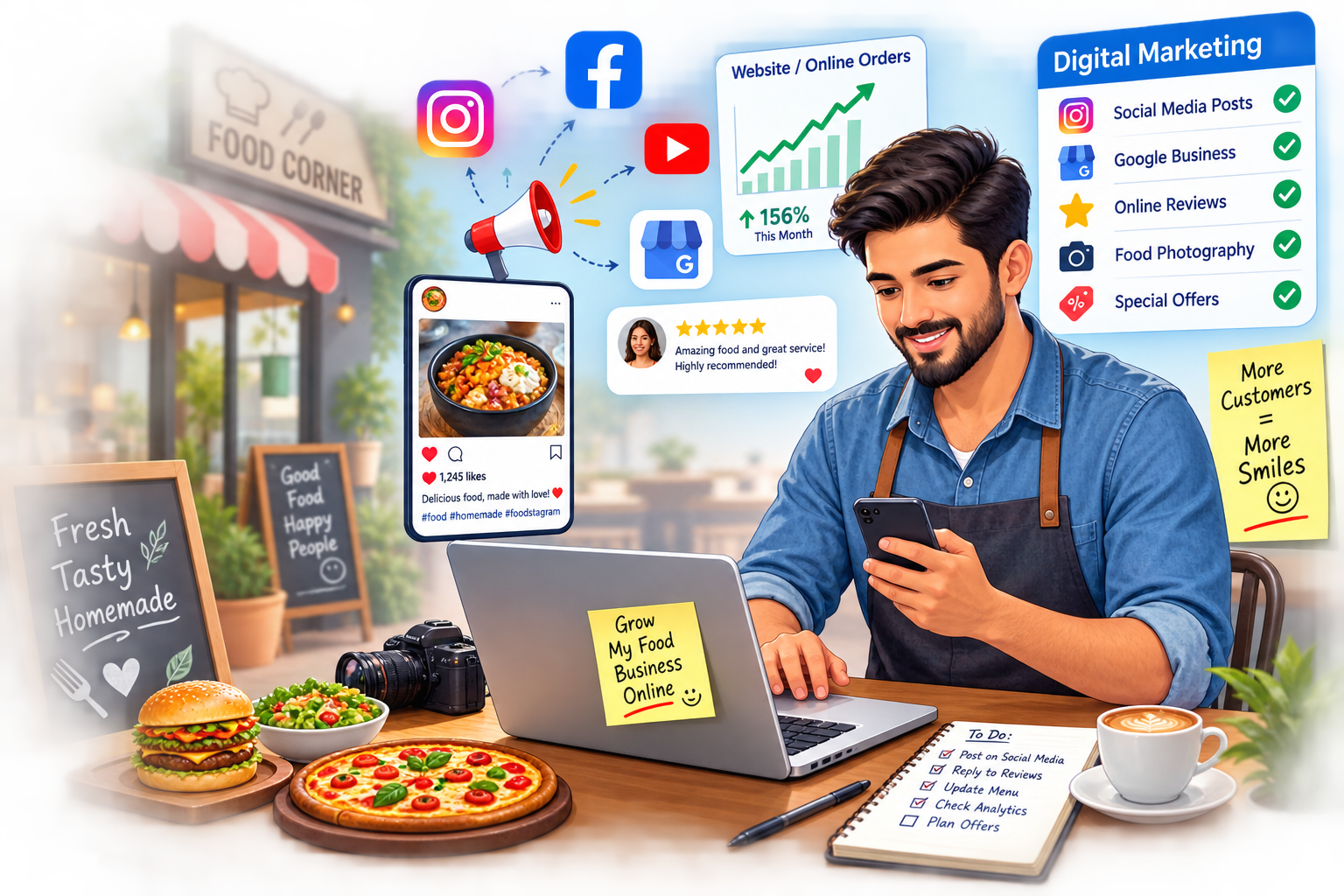
What Are Free Digital Marketing Services for Food Businesses?
Free digital marketing services are online marketing activities that you can do without paying an agency or purchasing advertising.
That doesn’t mean they require no effort.
You still need to invest your time, creativity, consistency, and knowledge of your customers.
For a food business, free marketing can include:
- Creating and optimizing a Google Business Profile
- Improving your website’s SEO
- Creating useful food-related content
- Posting regularly on social media
- Responding to Google reviews
- Adding your menu online
- Creating local business listings
- Using WhatsApp to communicate with customers
- Collecting customer reviews
- Creating short-form videos
- Optimizing your business for local searches
- Building relationships with local websites and food bloggers
These activities form the foundation of food business digital marketing.
And unlike paid ads, many of these efforts can continue generating visibility after you’ve done the initial work.
Why Digital Marketing Matters for a Food Business
Think about how people choose where to eat today.
Someone might search:
“best biryani near me”
Another person might search:
“vegetarian restaurant near me”
Someone else might see a restaurant’s Instagram video before deciding where to have dinner.
A customer may also check:
- Google reviews
- Food photos
- Menu
- Opening hours
- Location
- Price range
- Website
- Instagram profile
- Customer comments
Your online presence can therefore influence the customer’s decision before they ever contact you.
This is why food digital marketing isn’t simply about getting more followers.
It is about making it easier for the right customer to:
Discover → Trust → Contact → Visit → Order → Return
10 Free Digital Marketing Services for Food Business Owners
1. Create and Optimize Your Google Business Profile
For most local food businesses, this should be one of your first priorities.
A Google Business Profile can help your restaurant, cafe, bakery, or other food business appear when people search for relevant businesses on Google Search and Maps.
Make sure your profile contains accurate information such as:
- Business name
- Correct category
- Address
- Phone number
- Opening hours
- Website
- Menu
- Food photos
- Interior/exterior photos
- Services
- Attributes where applicable
Don’t simply create the profile and forget about it.
Keep the information updated.
If your restaurant changes its opening hours, update them.
If you introduce a new menu, add it.
If you have attractive new food photographs, upload them.
Why this matters
A customer searching for a restaurant doesn’t have much patience.
If they cannot quickly find your location, opening hours, menu, or phone number, they may simply choose another business.
2. Use Local SEO to Get Found by Nearby Customers
Local SEO is particularly important for food businesses because most customers aren’t looking for a restaurant on the other side of the country.
They’re looking for something close to where they live, work, shop, or travel.
For example:
“best cafe in Hyderabad”
“pizza restaurant near me”
“bakery in Banjara Hills”
“best biryani near me”
“family restaurant in Hyderabad”
Your website and Google Business Profile should clearly communicate what you offer and where you operate.
Create useful pages and content around genuine customer searches rather than repeating the same keyword everywhere.
For example, a bakery could create content such as:
“Best Birthday Cakes in Hyderabad: What to Consider Before Ordering”
That gives you an opportunity to naturally discuss:
- Cake sizes
- Flavors
- Custom designs
- Delivery areas
- Ordering time
- Pricing considerations
This is much more useful than creating a page that simply repeats “best bakery in Hyderabad” twenty times.
3. Ask Happy Customers for Genuine Reviews
Reviews are one of the most valuable forms of user-generated content for a local food business.
If someone genuinely enjoyed their meal, service, delivery, or experience, make it easy for them to leave a review.
You can ask after:
- A successful dine-in experience
- A completed catering order
- A positive delivery experience
- A repeat purchase
- A special event
Don’t buy reviews or create fake ones.
Instead, build a simple habit:
Good experience → politely ask → customer leaves genuine feedback
You can also respond to reviews professionally.
For example:
“Thank you for visiting us. We’re glad you enjoyed the biryani and appreciated the service. We hope to see you again soon.”
For a negative review, avoid becoming defensive. A calm and helpful response can demonstrate that you actually care about customers.
4. Turn Your Food Photos Into Marketing Content
You don’t necessarily need an expensive camera.
A modern smartphone, good lighting, a clean background, and some attention to composition can produce useful content.
Try photographing:
- Signature dishes
- New menu items
- Behind-the-scenes preparation
- Fresh ingredients
- Restaurant interiors
- Staff
- Packaging
- Customer experiences
- Special events
But don’t make every post look like an advertisement.
People enjoy seeing the story behind the food.
For example:
Instead of:
“Chicken biryani available. Order now.”
Try:
“We start preparing our biryani early because the flavor doesn’t come from rushing the process.”
Then show the preparation.
That’s where food business digital marketing becomes more personal.
5. Use Instagram and Facebook Organically
You don’t have to run advertisements immediately.
Start by creating useful organic content.
For example, a cafe could post:
Monday
Behind-the-scenes coffee preparation
Wednesday
A customer favorite
Friday
Weekend special
Sunday
A short video showing the cafe atmosphere
You can also experiment with:
- Reels
- Stories
- Short cooking videos
- Customer testimonials
- Staff introductions
- Polls
- Food preparation videos
- New product announcements
The goal isn’t to post simply because your content calendar says “post today.”
Ask:
“Why would a customer want to see this?”
That question alone can improve your social media content.
6. Create a Simple Website
A food business doesn’t necessarily need a complicated website when starting out.
A simple website can include:
- Home
- About
- Menu
- Contact
- Location
- Catering
- Delivery information
- Gallery
- Customer reviews
Make sure customers can quickly find:
What you sell + where you are + how to contact/order
Your website should also work properly on mobile devices.
For many food businesses, a customer may discover you while they’re already outside, traveling, or looking for somewhere to eat.
A slow or confusing mobile website can cost you that customer.
7. Publish Helpful Food-Related Content
Blogging can be a useful part of food digital marketing, especially when the content answers questions potential customers actually ask.
For example, a bakery could publish:
- How to choose the right birthday cake size
- Eggless cake options for celebrations
- How far in advance should you order a custom cake?
- How to store a birthday cake
- Popular cake flavors for children’s birthdays
A restaurant could create:
- Best dishes for a family dinner
- Vegetarian dishes to try
- What to order for a first visit
- How our biryani is prepared
- Catering checklist for a small event
This type of content can attract people who aren’t ready to buy immediately but may become customers later.
8. Use WhatsApp for Customer Communication
For many local businesses, WhatsApp can be extremely useful.
You can use it to:
- Answer customer questions
- Share menus
- Confirm catering requirements
- Send order information
- Communicate opening hours
- Handle enquiries
- Follow up with customers where appropriate
However, don’t turn WhatsApp into a spam channel.
Nobody wants to receive five promotional messages every week from a restaurant they visited once.
Use it primarily to provide useful and expected communication.
9. Submit Your Business to Relevant Local Directories
Local citations can help customers discover your business and can support your local SEO presence.
Look for legitimate directories relevant to your:
- City
- Food category
- Industry
- Local community
Keep your business information consistent wherever possible.
For example:
- Business name:
- Phone:
- Address:
- Website:
Don’t create dozens of low-quality directory profiles simply to obtain backlinks.
Quality and relevance matter more than the number of listings.
This is an important distinction between genuine free digital marketing services for small business and outdated “submit your business everywhere” SEO tactics.
10. Build Relationships With Local Businesses
One of the most overlooked free marketing opportunities is collaboration.
Suppose you own a bakery.
You could collaborate with:
- Event planners
- Wedding photographers
- Party organizers
- Local cafes
- Gift shops
- Corporate offices
- Wedding venues
A cafe could collaborate with:
- Local coworking spaces
- Book clubs
- Small businesses
- Artists
- Community groups
These relationships can lead to:
- Referrals
- Mentions
- Collaborations
- Events
- Social media exposure
- Local backlinks
This is a much more sustainable approach to digital marketing services for local businesses than chasing random backlinks.
Free Digital Marketing Services vs Paid Marketing
You might wonder:
“If free marketing works, why would I ever pay for digital marketing?”
The answer is that free and paid marketing serve different purposes.
Free marketing Paid marketing
Google Business Profile Google Ads
Organic SEO Search Ads
Organic social media Social media ads
Customer reviews Influencer campaigns
Local citations Paid directories
Content marketing Sponsored content
Referral marketing Paid partnerships
Email/WhatsApp communication Marketing automation
Free activities are an excellent foundation.
Paid marketing can then accelerate what is already working.
For example, if one particular dish consistently attracts customers organically, you might eventually run a targeted campaign around it.
How to Start Free Digital Marketing for Business
If you’re completely new to digital marketing, don’t try to do everything at once.
Start with this simple sequence.
Week 1: Set up your foundation
- Create/claim your Google Business Profile
- Correct your business information
- Add your website
- Add your menu
- Upload good-quality photographs
- Check your opening hours
Week 2: Start collecting trust signals
- Ask genuine customers for reviews
- Respond to existing reviews
- Add testimonials to your website
- Create social media profiles if you don’t already have them
Week 3: Start publishing
Create:
- 2–3 useful social posts
- 1 short video
- 1 helpful website article
- New food photographs
Week 4: Improve local visibility
Research:
- Local keywords
- Relevant directories
- Local partnerships
- Food bloggers
- Community websites
- Local event opportunities
Then repeat what works.
What If You’re Searching for “Free Digital Marketing Services Near Me”?
If you search for “free digital marketing services near me,” be careful about what you’re actually being offered.
Some agencies advertise a “free consultation,” “free audit,” or “free marketing service,” but the actual objective may be to sell you a paid package.
There’s nothing inherently wrong with that—but understand the difference.
Before accepting any free service, ask:
- What exactly is included?
- Is there any obligation?
- Will I need to sign a contract?
- Who owns the accounts?
- Will you need access to my website?
- What happens after the free period?
- Are there hidden charges?
For a small food business, you should retain ownership of important assets such as your website, domain, Google Business Profile, analytics accounts, and social media accounts.
Common Digital Marketing Mistakes Food Businesses Should Avoid
Free marketing doesn’t mean every free tactic is a good tactic.
Avoid these common mistakes.
Buying fake reviews
Fake reviews can destroy customer trust.
Focus on genuine feedback instead.
Keyword stuffing
Don’t write:
“Best restaurant Hyderabad restaurant best food Hyderabad restaurant…”
Write naturally for customers.
Buying cheap backlinks
Hundreds of irrelevant backlinks aren’t necessarily better than a few relevant mentions.
Posting only promotional content
If every social post says “ORDER NOW,” people will eventually stop paying attention.
Mix promotions with useful, entertaining, and behind-the-scenes content.
Ignoring negative reviews
Respond professionally instead of pretending they don’t exist.
Having outdated information
Incorrect opening hours or an old menu can frustrate customers.
Copying competitors
Your food, story, people, recipes, service, and customer experience are your advantages.
Show them.
How to Measure Your Free Marketing Efforts
One advantage of digital marketing is that you can measure many activities.
Track things such as:
- Google Business Profile interactions
- Website visitors
- Organic search traffic
- Phone calls
- Direction requests
- Website enquiries
- Menu views
- Social media engagement
- Reviews
- Online orders
- Repeat customers
Don’t obsess over follower counts.
A restaurant with 1,000 followers and 50 new customers can be doing better than one with 20,000 followers and almost no enquiries.
The business outcome matters more than the vanity metric.
A Simple Free Digital Marketing Strategy for a Small Food Business
If I were starting a small food business with almost no marketing budget, I’d keep the strategy simple:
Google Business Profile
↓
Local SEO
↓
Good food photography
↓
Useful social content
↓
Genuine customer reviews
↓
Simple website
↓
Helpful content
↓
Local partnerships
↓
Track enquiries and customers
↓
Invest in paid marketing only where it makes sense
You don’t need to master every digital marketing channel on day one.
You need to consistently do the few things that actually help customers discover and trust your business.
Frequently Asked Questions
Can I really promote my food business without spending money?
Yes. You can start with activities such as Google Business Profile optimization, organic social media, local SEO, customer reviews, content creation, local partnerships, and relevant business listings.
However, “free” doesn’t mean effortless. You’ll invest your own time.
What is the best free digital marketing service for a restaurant?
For many local restaurants, optimizing the Google Business Profile is one of the best places to start because customers frequently use Google to discover nearby restaurants and check important information before visiting.
How can I do free digital marketing for a small food business?
Start with Google Business Profile, local SEO, social media, genuine customer reviews, a simple website, food photography, useful content, and local partnerships.
Don’t try to launch every channel simultaneously.
Is SEO useful for a food business?
Yes. Local SEO can help your business appear when people search for relevant restaurants, cafes, bakeries, caterers, and other food businesses in your area.
Should a restaurant have a website?
A website isn’t always the first thing a very small business needs, but having one gives you a place to control important information such as your menu, location, services, contact details, and brand story.
Can social media bring customers to a food business?
Yes, particularly when the content shows the actual food, atmosphere, people, preparation process, customer experience, and offers. But social media results depend heavily on the quality and relevance of the content.
Are free digital marketing services enough to grow a food business?
They can provide a strong foundation, but they aren’t guaranteed to produce unlimited growth. As your business grows, you may decide to invest in paid advertising, professional SEO, photography, influencer campaigns, email marketing, or other channels.
How do I find free digital marketing services near me?
Search for local digital marketing organizations, business-development programs, community groups, educational initiatives, or agencies offering free consultations or audits. Before giving anyone access to your accounts, clarify exactly what is free and what happens afterward.